
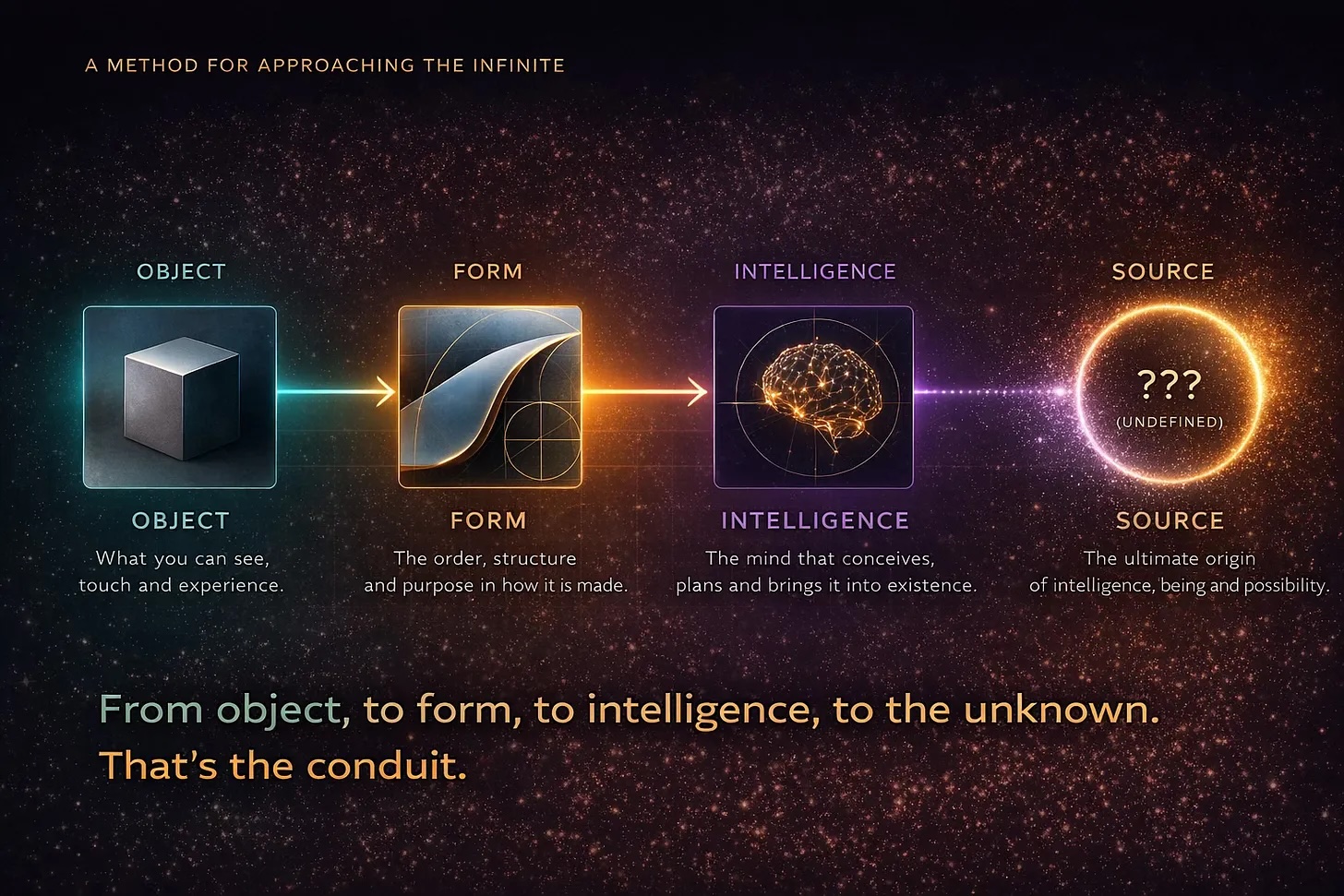
It may not be possible to directly “find” God—or whatever you consider the original source of all things—because something truly infinite is beyond the capacity of the human mind to fully comprehend or experience. Short of a miracle, our intellect is simply too limited. Waiting for such a moment is not a practical path to understanding.
So the question becomes: is there a method that allows a human mind, despite its limits, to approach or experience that infinite source?
I believe there is.
1. Build the Conduit
The first step is to develop what I would call a conduit—a mental connection between a creation and its creator. Think of it like a wire that carries electricity. Without the wire, there is no connection.
This conduit is not automatic. It is a skill that must be trained.
2. Start with Human Creation
Begin with things created by humans: art, architecture, music, engineering. A painting, a car, an airplane, a skyscraper. Choose anything you find beautiful or impressive.
Instead of focusing only on the object, shift your attention to its origin:
-
Someone imagined it.
-
Someone designed it.
-
Someone turned an idea into reality.
Every creation begins as a single idea in a human mind.
Even when many people are involved in building something, trace it back to the original act of creation—the first concept. Focus on that creator.
When you look at something like an airplane or a rocket, don’t stop at the object. Think about the human capacity behind it: the imagination, the design, the execution. Recognize that connection.
As you practice this, you are building the conduit—the mental link between creation and creator.
3. Make the Connection Instant
With repetition, this connection should become immediate. You see something, and your mind naturally moves from the object to the intelligence behind it.
At this point, the conduit is functioning.
4. Extend It to Nature
Once that ability is established, apply the same process to nature:
-
Trees
-
Flowers
-
Landscapes
-
Living systems
Use the same mental movement: from the thing to its source.
The difference is that, in this case, the creator is unknown.
5. Do Not Define the Creator
This is critical.
The moment you define God—or the source—in any terms, you limit it. Any image or concept you form is drawn from your own experience, biases, and intellectual boundaries. You reduce something potentially infinite into something finite.
It’s similar to forming assumptions about people without knowing them. Once you fix an idea in your mind, you stop seeing what is actually there.
If you believe you already know what God is—through religion, imagery, or definitions—you close off the possibility of encountering something beyond your current understanding. This is why Judaism and Islam, as well as Buddha, all prohibit the creation of any image of God, e that a statue, painting, anything that tries to convey the infinite into the finite.
6. Leave the End Open
The purpose of the conduit is not to arrive at a predefined answer. It is to create the possibility of a new kind of perception.
You move from:
-
A visible thing
-
To its unseen source
-
Without imposing a concept on that source
If the conduit is strong and the mind remains open, the result may be an unexpected shift in perception—what could be called an insight or realization.
7. Why Most People Don’t Reach This
Many people search for God but fail to make this connection. The issue is not effort, but method.
They try to connect directly to the abstract without first developing the ability to perceive the relationship between creation and creator.
Without the conduit, there is no connection—like a lightbulb without a wire to the power source.
8. Start Where You Are
Humans are grounded in the material world. We understand what we can see, touch, and study.
So the process begins there:
-
With real objects
-
With identifiable creators
-
With observable cause and effect
This is something you can verify, explore, and even experience directly.
Once that skill becomes natural, you can apply it beyond the material.
9. Progress Gradually
This is not an instant realization. It is a gradual development of the skill, the ability to see the invisible. This can even help you understand what someone is really saying, what they really mean when they speak in confusing or round about ways.
Work step by step. Build the connection carefully and consistently.
In that sense, progress is closer to the slow, steady path than a sudden breakthrough.
No comments yet — be the first to share your thoughts.